
Ellis County Probate Court
Probate in Ellis County is handled through the Probate Division of the District Court. The District Court clerk page lists probate as one of the record categories maintained by the Clerk of the District Court. Kansas does not place Ellis County probate filings in a separate county probate court. The same courthouse clerk structure handles probate filings, probate copies, and questions about public access to local probate case files.
Probate filings and copies should go through the Clerk of the District Court at 107 W. 12th Street in Hays. The office phone is 785-628-9415, and the published court email is Ellis_County_Clerk@kscourts.gov. The court office is open 8 a.m. to noon and 1 p.m. to 5 p.m., with the office closed to the public at 4:30 p.m.
Probate Division of the District Court
107 W. 12th Street
Hays, KS 67601
785-628-9415
Ellis_County_Clerk@kscourts.gov
Ellis County Probate Case Types
Probate records can involve property, money, family authority, and court supervision after a death or for a person who needs legal protection. Ellis County probate case types listed in the research include estates, wills, determination of descent, refusal to grant letters of administration, guardianships, conservatorships, trusteeships, termination of joint tenancy, small estate affidavits, inventories, accountings, notices to creditors, petitions, orders, and final distributions.
A small estate affidavit can be a different path from a full estate proceeding. Kansas Judicial Council official legal forms include probate forms and a Small Estates Affidavit tied to K.S.A. 59-1507b. A person choosing between a small-estate form, a full estate case, or a guardianship filing should confirm the required form and local filing steps with the clerk or legal counsel.
The Kansas small estates affidavit statute is one probate source assigned to Ellis County probate records.
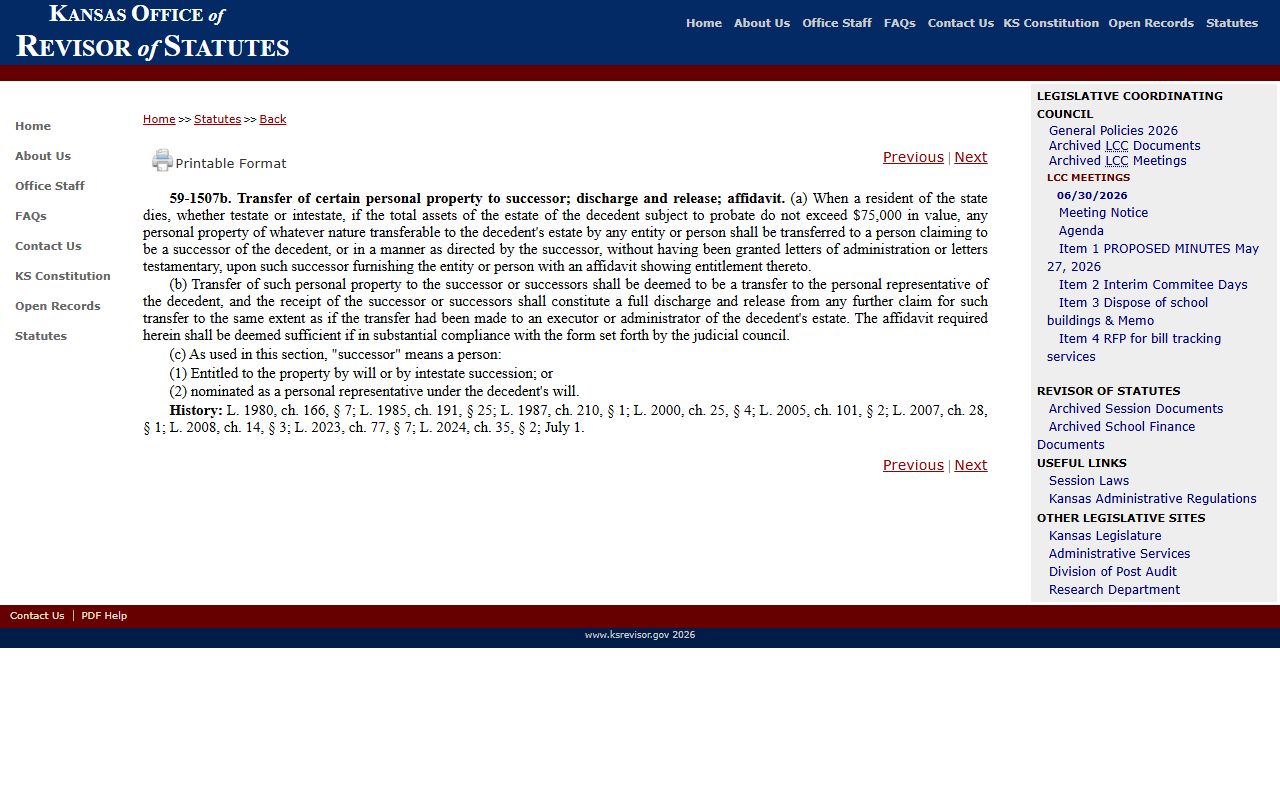
That statute matters when an estate may qualify for an affidavit path rather than a full probate estate filing.
Probate Terms Defined
Probate filings use terms that are easy to mix up. These definitions are plain-language starting points for reading Ellis County probate records. The court order, petition, and Kansas law control the exact role in a real case.
- Testator
- A person who made a will.
- Executor
- A person named to carry out a will and handle estate duties after court authority is granted.
- Intestate
- A death without a valid will, which can require property to pass under Kansas intestacy rules.
- Guardianship
- A court case that gives a person authority over another person's care or personal decisions.
- Conservatorship
- A court case that gives a person authority over another person's money or property.
Search Ellis County Probate Records
Public probate case information may be available through Kansas CaseSearch when the case is in the statewide district court system. No separate Ellis County probate-only search portal was located in the research. If the probate record is public but not online, Kansas Judicial Branch materials point users to the courthouse public-access terminal or the clerk. Older files, certified copies, sealed-record questions, and documents not visible online should be handled through the Clerk of the District Court.
- Identify the decedent, estate, protected person, case number, or filing party before searching.
- Search Kansas CaseSearch for public District Court probate case information if available.
- Use the courthouse public terminal or clerk counter if the public probate record does not appear online.
- Contact the Clerk of the District Court for copies, certified copies, older files, or access questions.
- Use Kansas Judicial Council forms when starting a probate, small estate, guardianship, or conservatorship matter, then confirm local filing requirements.
Note: No live Ellis County probate sample record was inspected during the research, so record-field claims stay general.
Ellis County Probate Fees
The official 23rd Judicial District fee schedule lists several probate filing fees used in Ellis County. Fees can change, and additional costs may apply for copies, notices, service, publication, or case-specific filings. The listed amounts are the probate items captured from the official research source.
| Probate Item | Fee |
|---|---|
| Filing will and affidavit | $70.50 |
| Determination of descent | $71.50 |
| Probate of estate or will | $131.50 |
| Refusal to grant letters of administration | $70.50 |
| Termination of joint tenancy | $70.50 |
| Conservatorship / guardianship | $91.50 |
| Trusteeship | $91.50 |
Ellis County Probate Records Show
A probate record may show a petition, will, affidavit, inventory, notice to creditors, accounting, hearing order, appointment of a fiduciary, letters, sale or transfer orders, guardianship or conservatorship filings, and final distribution. The contents depend on the type of case. A will filing is not the same record as a full estate administration, and a guardianship file may contain sensitive information not suitable for broad public viewing.
| Record Item | What It May Show |
|---|---|
| Petition | The requested probate action, such as estate administration, descent, guardianship, or conservatorship. |
| Will or affidavit | The testamentary document or sworn filing submitted to the court. |
| Inventory and accounting | Assets, debts, receipts, distributions, or supervised property information. |
| Notice to creditors | Information about creditor notice and claim periods in an estate case. |
| Orders and final distribution | The court's rulings, authority granted, and closing distribution or transfer directions. |
The Kansas Open Records Act title statute appears in the manifest as a probate record access source at K.S.A. 45-215.
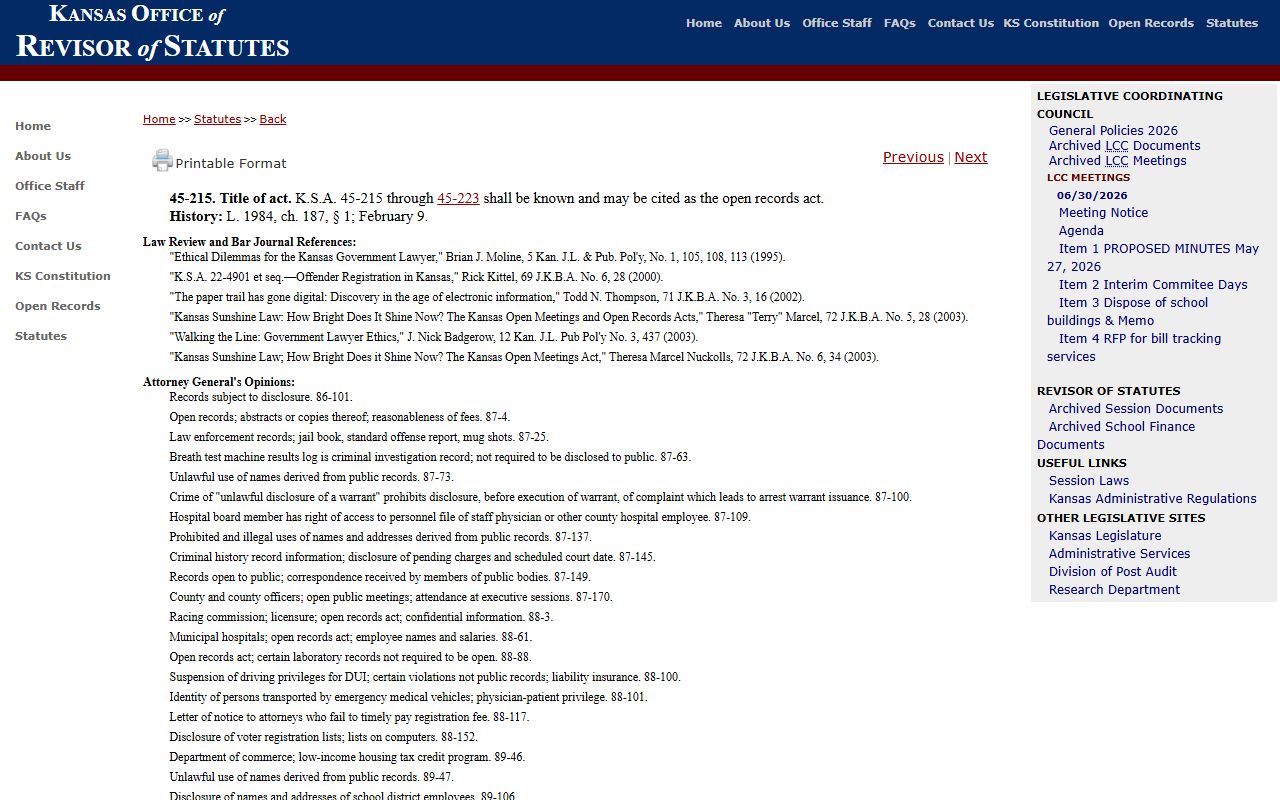
Open-records rules support access to public records, but court access rules and confidentiality limits still matter for probate files.
File Ellis County Probate Matters
The probate filing path starts with identifying the right case type. A decedent's estate, a will filing, a determination of descent, a refusal to grant letters, a guardianship, and a conservatorship are not interchangeable. The research supports a practical filing sequence that begins with the person, estate, or protected person and then matches the filing to the proper District Court category.
- Identify the decedent, estate, protected person, property, and case type.
- Use the Clerk of the District Court because probate is a District Court category in Ellis County.
- Use Kansas Judicial Council forms where available, including probate and small-estate categories.
- Pay the applicable filing fee from the official fee schedule.
- Follow court orders for notice, hearings, inventory, accounting, creditor claims, sale or transfer of property, and final distribution.
Probate can affect title, family rights, and protected-person authority. A person who needs a court order for estate property should not rely only on a search result.
Restricted Probate Records
Many probate records are public case records, but not every document is available online or open without limits. Guardianship and conservatorship matters can involve medical, financial, minor, or protected-person information. A court may seal or restrict material, and Kansas court access rules can limit electronic access even when a courthouse record remains public.
For a record that is not online, the fallback is the courthouse terminal or clerk contact. For a record that is sealed, confidential, or tied to a protected person, the clerk can explain the request path, but the court decides access. A related divorce, name, or family record may be found through the marriage and divorce records path when probate is not the right file type.
Kansas copy-fee authority appears in the assigned probate image source at K.S.A. 45-219.
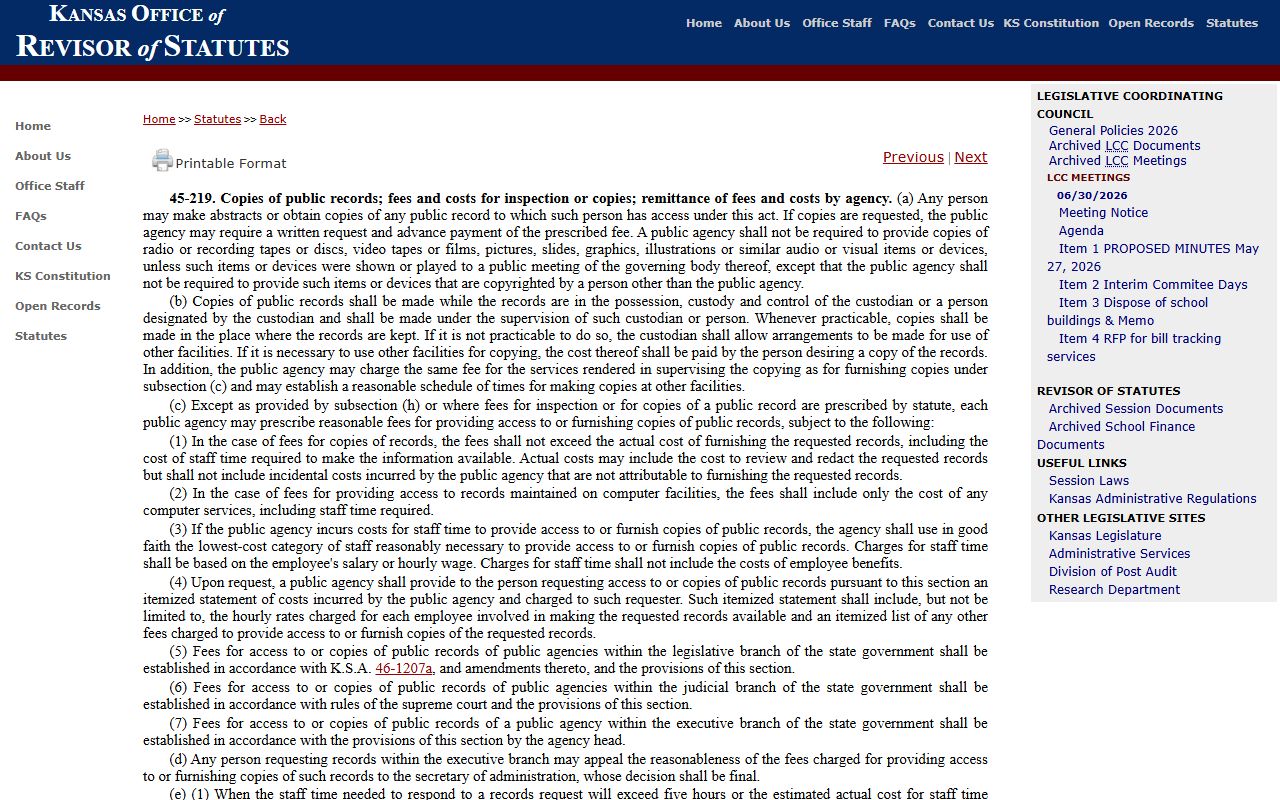
That statute supports the practical point that copy access and copy costs are separate from filing fees in a probate case.